In the first two articles, we explored why someone might harness flatulence for energy and how a hypothetical device could convert gas into usable electricity. But technology doesn’t exist in a vacuum. Whether it’s an ordinary smartphone or a futuristic “fart reactor,” people’s perceptions — shaped by culture, etiquette, and taboo — can make or break innovation. In this third article, we examine how body-powered devices might shift social norms, why humour can help, and where personal comfort and privacy fit into the picture.
[Speculative Design Fart Reactor](https://medium.com/@diyaz.yakubov/speculative-design-fart-reactor-35c1d7b6ef5b)
1.From Taboo to Technology : Why farts might be worth harnessing.
2.Inside the Fart Reactor : A look at the hypothetical mechanics.
3.Breaking the Silence : Social and cultural impacts of body-powered devices. 👈
4.Beyond Farts : Other human-based bioenergy innovations.
5.Design Challenges : Comfort, efficiency, and privacy concerns.
6.Ethics and Ownership : Who controls the data tied to our bodily by-products?
7.Speculative Futures : Where human-powered tech could lead us next.
1. The Taboo Factor
From Shame to Show-and-Tell?
Flatulence is a near-universal taboo in many societies. The very act is often hidden, joked about, or censored. Turning it into a power source directly challenges that silence. By pushing something “unmentionable” into a public-facing utility, we spark conversations about:
- Body Positivity : Normalizing natural functions rather than viewing them as shameful.
- Environmental Stewardship : Reframing waste as a resource, encouraging sustainable habits at an intimate level.
Cultural Variations
Historically, attitudes aren’t uniform. The 19th-century Japanese He-Gassen scrolls humorously depicted flatulence in art, while French entertainer Joseph Pujol (“Le Pétomane”) made an entire stage career out of controlling and performing with his gas in late 19th-century France. These examples show that what’s taboo in one context can be playful or even celebrated in another.
2. Humour’s Role in Acceptance
Breaking the Ice
Humour is one of the most powerful tools for easing discomfort. By embracing the comedic element of a “fart reactor,” designers and advocates can:
- Disarm Criticism : Acknowledge the silliness upfront, making people more open to hearing the serious benefits.
- Foster Openness : Jokes can transform awkwardness into curiosity, paving the way for deeper discussions about sustainability.
Risks of Trivialization
At the same time, too much humour may undermine the device’s credibility. If it’s perpetually seen as a gag gadget, the real-world potential — whether for micro energy generation or public awareness — might never gain traction. Striking a balance between levity and legitimacy is key.
3. Personal Comfort & Privacy
Bodily Boundaries
A wearable that captures flatulence blurs lines between personal, private functions and public technology. Some users may be fine with it, while others might find it invasive or embarrassing:
- Data Concerns : Could these devices track not just the volume of gas, but also chemical makeup? Who owns this data?
- Medical Insights : On the positive side, gas composition data might reveal information about one’s diet or gut health — but consent and confidentiality matter.
Normalization Over Time
Think of how fitness trackers were once unusual — now, step counts and heart-rate data are openly shared. Similarly, if body-powered devices become mainstream, public sentiment could shift from “That’s so weird!” to “Oh, I see you’re charging your smartwatch.”
4. Social Hierarchies and Identity
Early Adopters vs. Skeptics
If a “fart reactor” ever gained commercial traction, it might be championed by eco-conscious trendsetters. Yet, many would remain hesitant, worried about social ridicule. This dynamic mirrors adoption patterns for many new, stigmatized products — from electric cars once considered “odd” to the widespread use of reusable menstrual products.
Transforming Status
In some speculative futures, a personal biogas device could become a badge of environmental commitment. Much like driving a hybrid car can signal one’s values, wearing a body-powered device might project eco-savviness. Alternatively, it might remain niche, only championed by sustainability hobbyists or outliers comfortable challenging social norms.
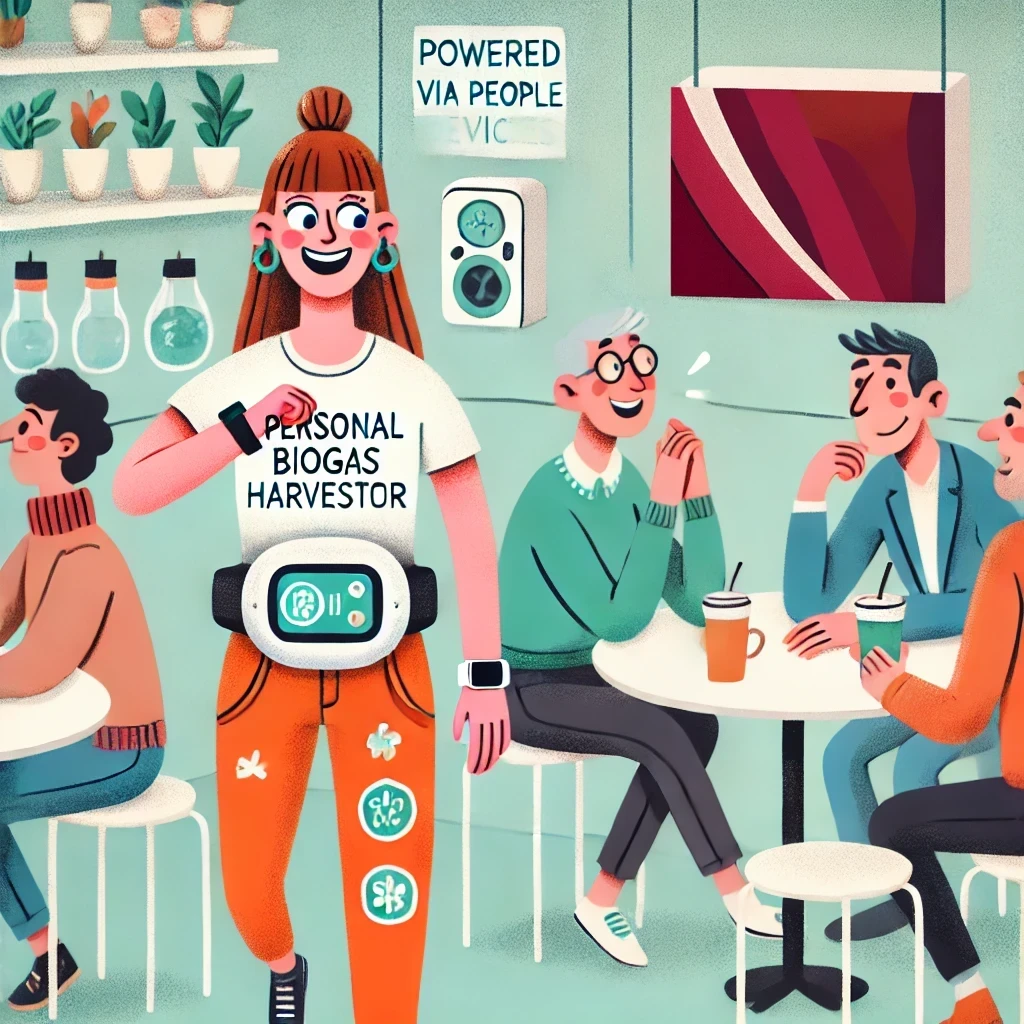 It became a norm
5. Looking Ahead
Body-powered devices will likely provoke a broad spectrum of responses — from humour and acceptance to mockery or outright rejection. Yet, by leaning into comedy, emphasizing privacy, and highlighting genuine environmental benefits, designers can carve a path toward mainstream understanding — if not universal adoption. The more we talk openly about these concepts, the easier it becomes to break down cultural barriers and spark creative thinking about renewable energy at the most personal level.
In the next article, we’ll spotlight other forms of human-generated bioenergy — from urine to sweat — to see how these “odd” ideas have already emerged in the lab and in limited real-world applications. By expanding our perspective, we’ll better understand how capturing human waste for power is less a wild invention and more a glimpse into what might be possible if we shift our collective mindset.
Comments