Harnessing human-powered energy sounds exciting — until you have to wear the hardware all day. Whether we are talking about a sweat-fuelled patch, a body-heat generator, or our tongue-in-cheek “fart reactor,” all body-centric devices run up against three stubborn hurdles: comfort , energy efficiency and data/privacy. Below is a snapshot of the biggest obstacles researchers and designers face, together with recent evidence and emerging workarounds.
[Speculative Design Fart Reactor](https://medium.com/@diyaz.yakubov/speculative-design-fart-reactor-35c1d7b6ef5b)
1.From Taboo to Technology : Why farts might be worth harnessing.
2.Inside the Fart Reactor : A look at the hypothetical mechanics.
3.Breaking the Silence : Social and cultural impacts of body-powered devices.
5.Design Challenges : Comfort, efficiency, and privacy concerns. 👈
6.Ethics and Ownership : Who controls the data tied to our bodily by-products?
7.Speculative Futures : Where human-powered tech could lead us next.
Comfort And Wearability
https://cdn.embedly.com/widgets/media.html?src=https%3A%2F%2Fdatawrapper.dwcdn.net%2Fg5NP2%2F1%2F&display_name=Datawrapper&url=http%3A%2F%2Fdatawrapper.dwcdn.net%2Fg5NP2%2F1%2F&image=https%3A%2F%2Fdatawrapper.dwcdn.net%2Fg5NP2%2Fplain-s.png%3Fv%3D1&type=text%2Fhtml&schema=dwcdn
Energy Efficiency
Even a raincoat’s worth of sweat yields only milliwatts. In practice, the tiny currents from body-powered gadgets fall far short of a phone or smartwatch’s needs. For instance, researchers developed a printable sweat-powered biofuel patch that ran a small lactate sensor and Bluetooth link. In tests it produced about 4.3 mW at 3.66 V 4 — enough to power a fitness meter for 1½ hours from just a drop of sweat 4. That sounds promising, but a basic activity tracker still needs 10–20× more power (typically ~1–2 mW) to run continuously [5]. Likewise, body-heat generators (thermoelectric modules) can scavenge some watts, but only with bulky heat sinks and only when skin is uncovered . In short, human-harvested power is real but meager [5].
Boosting efficiency usually means tradeoffs. To squeeze more juice out of sweat, scientists have “3D-engineered” electrodes — growing carbon-nanotube sponges to expose far more enzyme-catalyst surface to the body’s fluids [5]. Other teams weave micro-TEGs into clothing or add tiny motion harvesters in shoes. Every tweak adds complexity (and sometimes stiffness), so researchers are also working on smarter power management: buffering energy in thin-film supercapacitors, duty-cycling sensors, and offloading data bursts only when needed. In the lab this has raised performance — one headband fuel cell reached ~100 μW/cm² [5] (about twice what a small heat-driven TEG could muster under clothing). But real-world wearables still run out of power within hours, not days.
Data and Privacy
Perhaps the biggest hurdle is that these devices must know everything about you to work — and that scares people. Modern wearables gather heart rate, motion, sweat chemistry, even core temperature. Employers are already using armbands and patches (similar to lab prototypes) to flag heat-stress in workers [6]. The problem is data retention. In one report, companies kept years of biometric logs on employees — and privacy advocates warn it can be abused. As one expert put it, long-term health data could let bosses “kick an employee off a health plan or fire them” [6]. In other words, a life-tracking gadget might double as a surveillance tool.
To address this, experts urge strict safeguards. Workers should be allowed to opt in (or out) of monitoring, and the sensor platform must process only the data it truly needs and delete it quickly [6]. Some designers propose on-device encryption or edge-computing so raw metrics never leave the device. In speculative designs, people imagine fuel-harvesting “smart clothing” that never broadcasts sensitive data — instead computing alerts locally (e.g. a vibration warning for overheating) [6]. Privacy-by-design will be crucial: without it, even the coolest self-powered gadget will feel too intrusive to wear every day.
Harnessing human power is a poetic idea: every step, every heartbeat, every breath could keep our devices alive. But until designers solve the “big three” — comfort, efficiency, and privacy — these gadgets risk being novelties rather than necessities. The future will likely come not from squeezing out one more microwatt, but from rethinking the contract between humans and machines: how much energy we can give, how much data we should share, and how much discomfort we’re willing to endure. Speculative design reminds us that technology is never just technical — it’s also ethical, social, and deeply human.
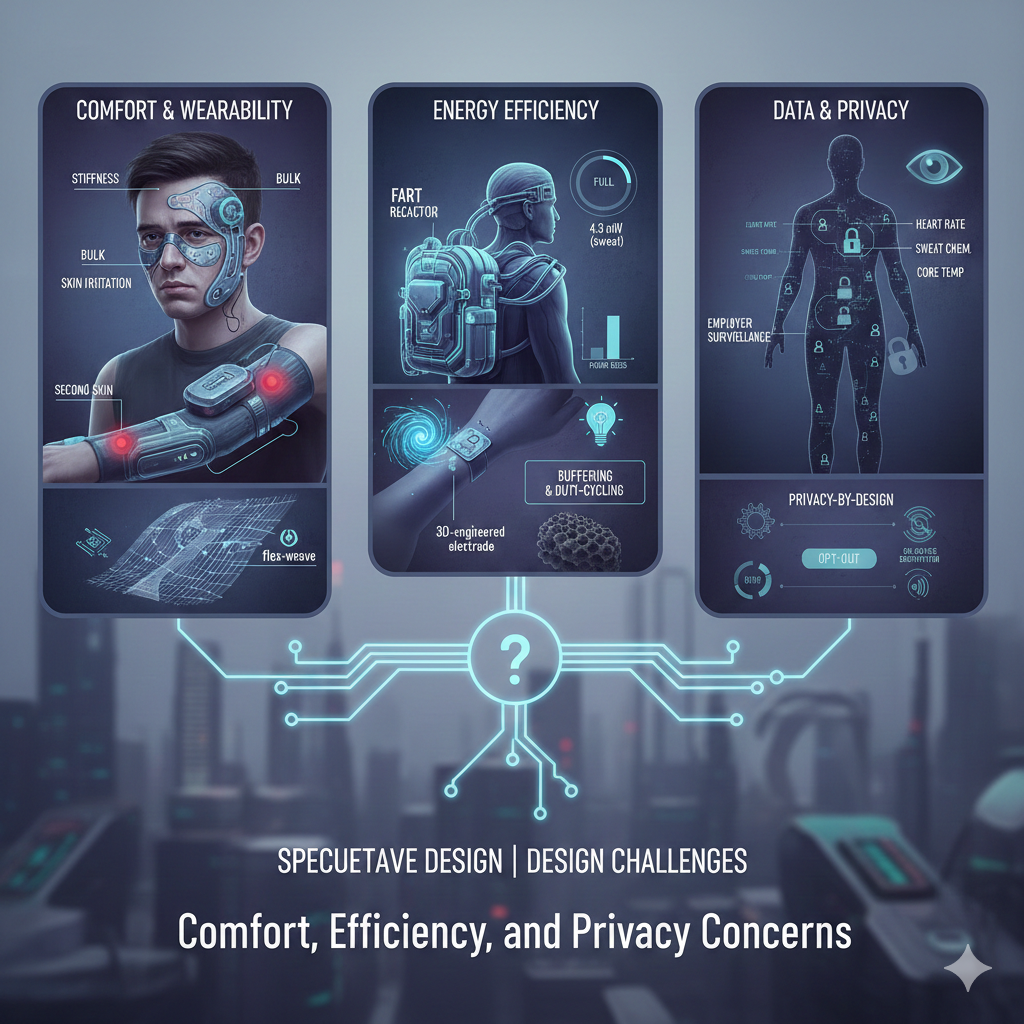 Speculative Design | Design Challenges: Comfort, efficiency, and privacy concerns
References
[5] Why Sweat Will Power Your Next Wearable
[6] Sensors can read your sweat and predict overheating. Here’s why privacy advocates care
Comments