So far in our speculative bioenergy series, we’ve explored the provocative idea of turning flatulence into energy. Yet, human-generated bioenergy doesn’t end there. Innovative researchers and designers worldwide are harnessing other forms of bodily output — from urine and sweat to body heat and motion — to produce usable electricity. These real-world advancements provide crucial context, demonstrating how converting bodily waste and by-products into energy is already transforming sustainability, public health, and design.
[Speculative Design Fart Reactor](https://medium.com/@diyaz.yakubov/speculative-design-fart-reactor-35c1d7b6ef5b)
1.From Taboo to Technology : Why farts might be worth harnessing.
2.Inside the Fart Reactor : A look at the hypothetical mechanics.
3.Breaking the Silence : Social and cultural impacts of body-powered devices.
4.Beyond Farts : Other human-based bioenergy innovations. 👈
5.Design Challenges : Comfort, efficiency, and privacy concerns.
6.Ethics and Ownership : Who controls the data tied to our bodily by-products?
7.Speculative Futures : Where human-powered tech could lead us next.
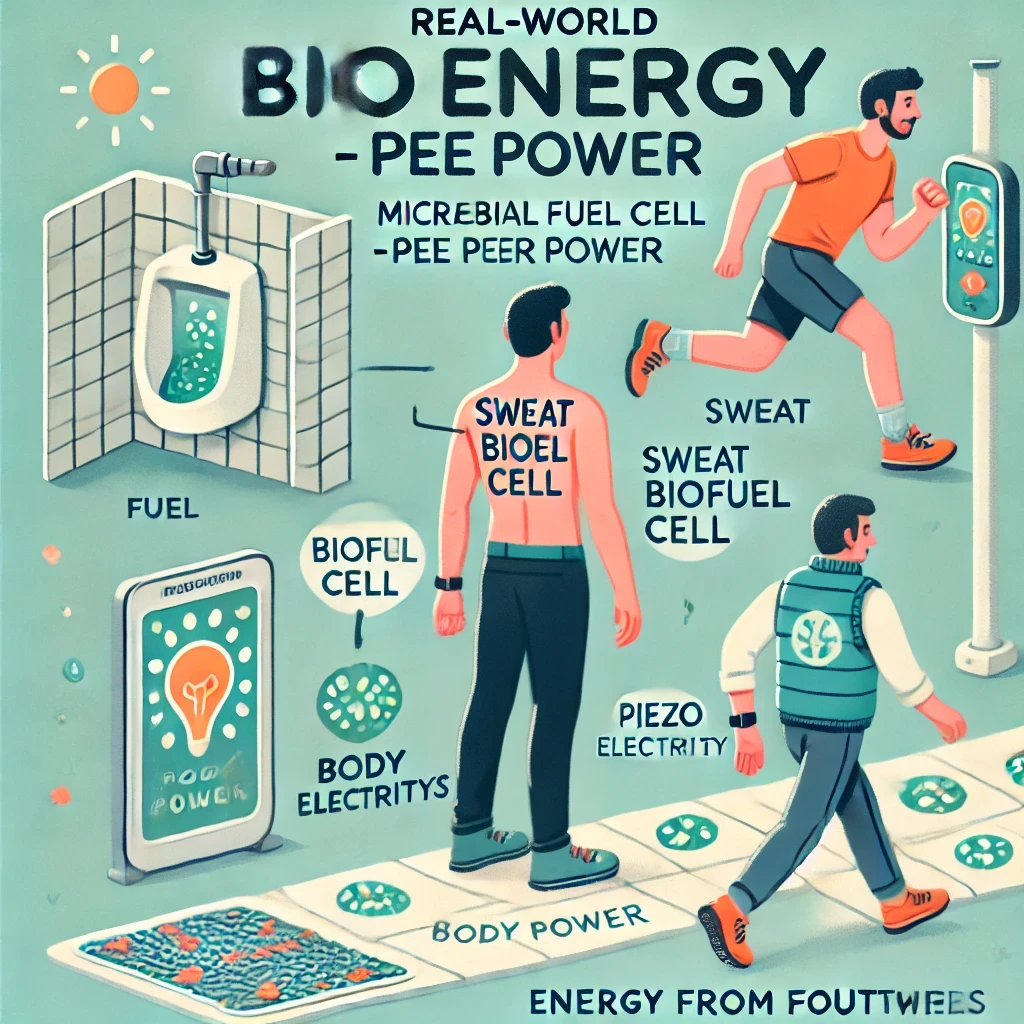
1. Urine-Based Electricity: Microbial Fuel Cells (MFCs)
The Technology
Microbial fuel cells use microorganisms to break down organic matter — in this case, urine — and produce electricity in the process. The bacteria metabolize compounds found in urine, releasing electrons that generate a measurable electrical current.
Evidence & Real-World Application
- Researchers at the University of the West of England have successfully developed “Pee Power” urinals capable of generating enough electricity to power LED lights and small mobile devices, demonstrating genuine practical application of MFC technology (Ieropoulos et al., 2013; Walter et al., 2016).
- The success of Pee Power technology at Glastonbury Festival(a large music event in the UK) showed how microbial fuel cells could effectively function at scale, capturing electricity from festival-goers’ urine to power lighting (Ieropoulos et al., 2016).
Impact
MFCs could play a pivotal role in rural or disaster-hit regions, offering affordable sanitation solutions while generating off-grid electricity.
2. Sweat Power: Biofuel Cells in Wearables
The Technology
Sweat contains lactate, glucose, and electrolytes — substances biofuel cells can convert directly into electrical energy. Wearable sensors and small medical devices can thus draw power directly from human sweat.
Evidence & Real-World Application
- Researchers at the University of California San Diego created a wearable patch capable of generating continuous electrical power directly from sweat to power health sensors (Bandodkar et al., 2017).
- Sweat-powered biofuel cells have demonstrated sufficient power to continuously drive biosensors and Bluetooth communication modules in wearable devices, making battery-free, self-sustaining wearable tech feasible (Yu et al., 2020).
Impact
Sweat-powered devices can significantly extend the life and reduce the environmental waste associated with disposable batteries, making wearable technology truly sustainable.
3. Body Heat: Thermoelectric Generators
The Technology
Thermoelectric generators (TEGs) convert heat differences into electrical energy. When applied to wearable tech, the difference between body heat and ambient temperature generates small but consistent amounts of electricity.
Evidence & Real-World Application
- Scientists at North Carolina State University developed flexible thermoelectric devices capable of harvesting body heat to power wearable electronics, such as fitness trackers or health monitoring patches (Kim et al., 2014).
- Seiko introduced a wristwatch powered solely by body heat, highlighting the commercial viability and practical integration of thermoelectric generation into consumer products (Leonov, 2013).
Impact
TEGs harness otherwise wasted thermal energy, offering continuous, battery-free solutions for personal electronics and medical wearables, enhancing sustainability and user convenience.
4. Motion and Footsteps: Piezoelectricity
The Technology
Piezoelectric devices convert mechanical energy, such as footsteps or muscle movements, into electrical energy through material deformation.
Evidence & Real-World Application
- Pavegen tiles installed in cities worldwide capture energy from pedestrian footsteps, powering streetlights, sensors, and signage, demonstrating viable urban renewable energy (Pavegen, 2023).
- Harvard researchers developed piezoelectric clothing capable of generating electricity from everyday bodily motions like walking or breathing (Dagdeviren et al., 2014).
Impact
Piezoelectric energy capture integrates seamlessly into daily routines, providing passive, continuous energy to support urban infrastructure and wearable technology.
Why These Innovations Matter
Human-based bioenergy innovations, while initially strange or speculative, underline a crucial shift: what we consider waste or mere bodily functions can become valuable renewable resources. Such innovations:
- Enhance sustainability : Reducing reliance on disposable batteries and fossil fuels.
- Improve public health : Enabling battery-free medical sensors and accessible sanitation.
- Transform cultural perceptions : Encouraging more comfortable, pragmatic discussions around bodily functions and sustainability.
These technologies demonstrate that speculative concepts like our “fart reactor” aren’t as far-fetched as they first appear. Instead, they sit alongside genuine scientific and commercial efforts, pushing us toward a more integrated, sustainable future.
References And Further Reading
- Ieropoulos, I. A., Greenman, J., & Melhuish, C. (2013). “Urinal tryst: how microbial fuel cells can harness urine to generate electricity.” Bioinspiration & Biomimetics, 8(4).
- Walter, X. A., Merino-Jiménez, I., Greenman, J., & Ieropoulos, I. (2016). “Pee power urinal — microbial fuel cell technology field trials in the context of sanitation.” Environmental Science: Water Research & Technology, 2(2), 336–343.
- Bandodkar, A. J., Jeang, W. J., Ghaffari, R., & Rogers, J. A. (2017). “Wearable sensors for biochemical sweat analysis.” Annual Review of Analytical Chemistry, 10, 181–203.
- Yu, Y., Nyein, H. Y. Y., Gao, W., & Javey, A. (2020). “Flexible electrochemical bioelectronics: the rise of in situ bioanalysis.” Advanced Materials, 32(15).
- Kim, S. J., We, J. H., & Cho, B. J. (2014). “A wearable thermoelectric generator fabricated on a glass fabric.” Energy & Environmental Science, 7(6), 1959–1965.
- Leonov, V. (2013). “Thermoelectric energy harvesting of human body heat for wearable sensors.” IEEE Sensors Journal, 13(6), 2284–2291.
- Dagdeviren, C., Yang, B. D., Su, Y., Tran, P. L., Joe, P., Anderson, E., & Rogers, J. A. (2014). “Conformal piezoelectric energy harvesting and storage from motions of the heart, lung, and diaphragm.” Proceedings of the National Academy of Sciences, 111(5), 1927–1932.
- Pavegen (2023). Official Website. Retrieved from: https://www.pavegen.com
Comments