Social intelligence shouldn’t cost more than a junior salary.
Most of the social intelligence software out there is priced for Fortune 500 procurement teams. I’m building one that isn’t.
I’ve spent years around social platforms and the same pattern kept showing up: the deepest, most useful tools are locked behind sales calls and five-figure contracts. The teams that need this kind of data the most — small agencies, in-house marketers at growing brands, academic researchers — often can’t justify the spend. So they cobble together screenshots and gut feel. That’s the gap busypipe is built for.
What busypipe is
busypipe is a social intelligence platform. Today it focuses on TikTok. Soon, Instagram and YouTube.
The product is built around one idea: you should be able to track the accounts you don’t own. Competitors. Influencers you work with. Rising creators in your category. Hashtags and sounds that are starting to move in a specific market.
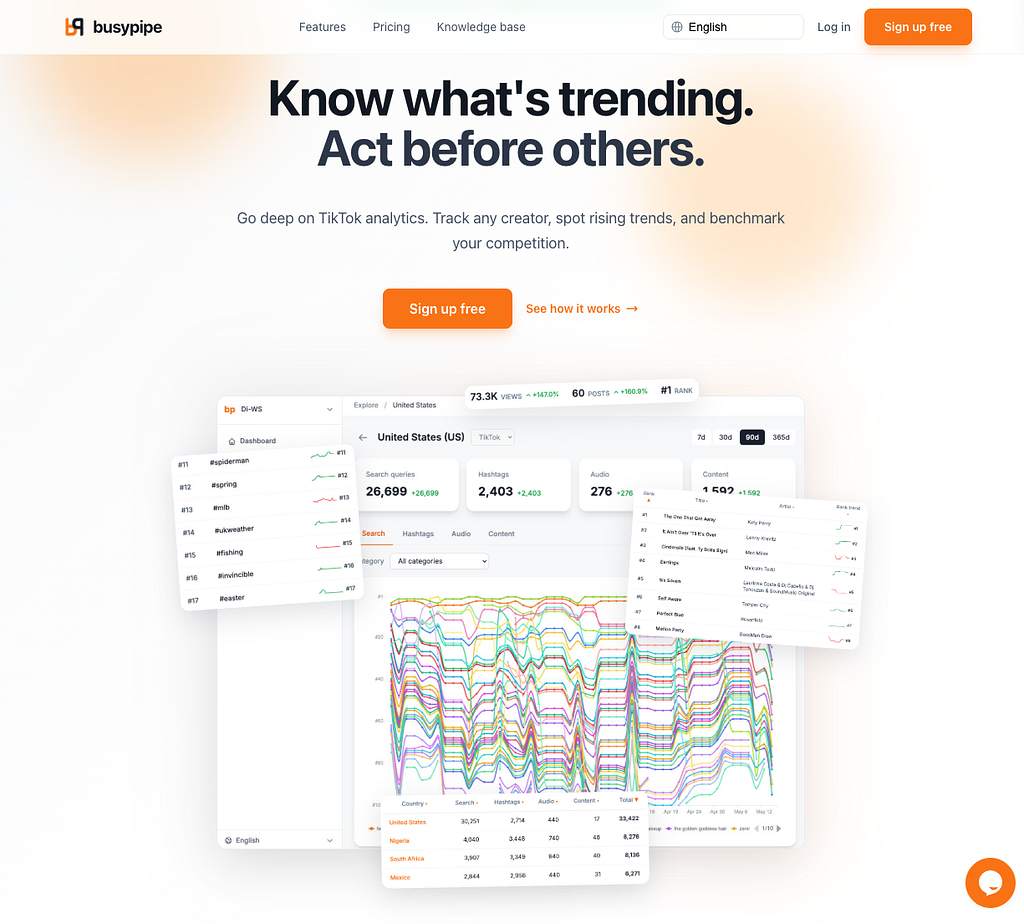
You add the profiles, hashtags, or sounds you care about into a portfolio. The platform then tracks them continuously — follower growth, engagement rate, posting cadence, regional performance, trending audio — and gives you charts and tables you can drop into Monday’s deck.
That’s it. Not a publishing tool. Not a social inbox. Not a 25-platform listening suite. Just deep, organised intelligence on the platforms that actually matter to your audience.
Why I’m building it
Honestly? Because I see the opportunity, I know the field, and I want to earn a living doing something useful.
The big names in this space — Meltwater, Brandwatch, Sprout — are excellent. They are also priced for enterprise buyers. Annual contracts in the tens of thousands. Demos required. Six-month implementations. That works fine when you’re a global PR team. It does not work when you’re a four-person agency running ten client accounts, or a marketing lead at a growing DTC brand, or a PhD student studying how trends move across regions.
I want to make this kind of intelligence accessible. That means flat pricing per workspace instead of per seat. A free plan that’s actually useful. Self-serve sign-up with no demo and no sales call. And a price tag a small agency can put on a credit card without flinching.
There’s a second audience I care about: researchers in the social sciences. Academia needs structured, long-term social data, and right now the options are either enterprise rates they can’t afford or collecting it by hand. I want to serve them too — with a different angle, and with pricing that respects the reality of a research budget.
A note on trust (especially for researchers)
There’s something I want to name up front, because it tends to get glossed over: the numbers a platform shows you today are not the same as what it showed you yesterday — and probably not what it’ll show you tomorrow. They are what the platform chose to expose, on the day it chose to expose it.
Things that worked last month stop working. Numbers move around for no clear reason. Whole categories of data disappear without notice. Anyone who has tried to reproduce a finding six months later knows the feeling.
busypipe handles this by preserving the original snapshot of what the platform showed us, before anything is summarised or scored. If the platform later changes its mind about what it showed yesterday, our copy is still there. The record stays honest even when the source moves.
It’s also why I’d encourage anyone using any social intelligence tool — mine included — to ask: do you preserve the original data, or only the processed numbers? What happens when a platform quietly changes what it shows? If they can’t answer that, treat the numbers carefully.
How to use it
Sign up. Pick a few accounts you care about — competitors, influencers, your own brand. Drop them into a portfolio. Come back in a week.
You’ll see growth curves, engagement trends, post-by-post performance, what hashtags they’re leaning into, what sounds they’re riding, and how their content lands in different regions. Download a spreadsheet when you need to send something to a client.
And soon, you’ll be able to share a live analytics view with anyone — a teammate, a client, a stakeholder, a thesis advisor — without giving them a seat or asking them to log in. A link is enough. The view stays live and updates as new data comes in.
There’s a free plan for three tracked profiles. Enough to kick the tyres and decide if the product earns a paid slot in your stack.
Where it goes from here
TikTok first, because that’s where the most movement is happening and existing tools are the thinnest. Instagram and YouTube next. Comments, transcripts, shareable analytics, and a layer of post-level intelligence — what kind of hook a video opens with, how strong it actually is — are rolling out as I write this.
If you want to follow along, or kick the tyres, busypipe.com is the place.
If you’re a researcher with a use case I should know about, I’d like to hear from you.
Comments